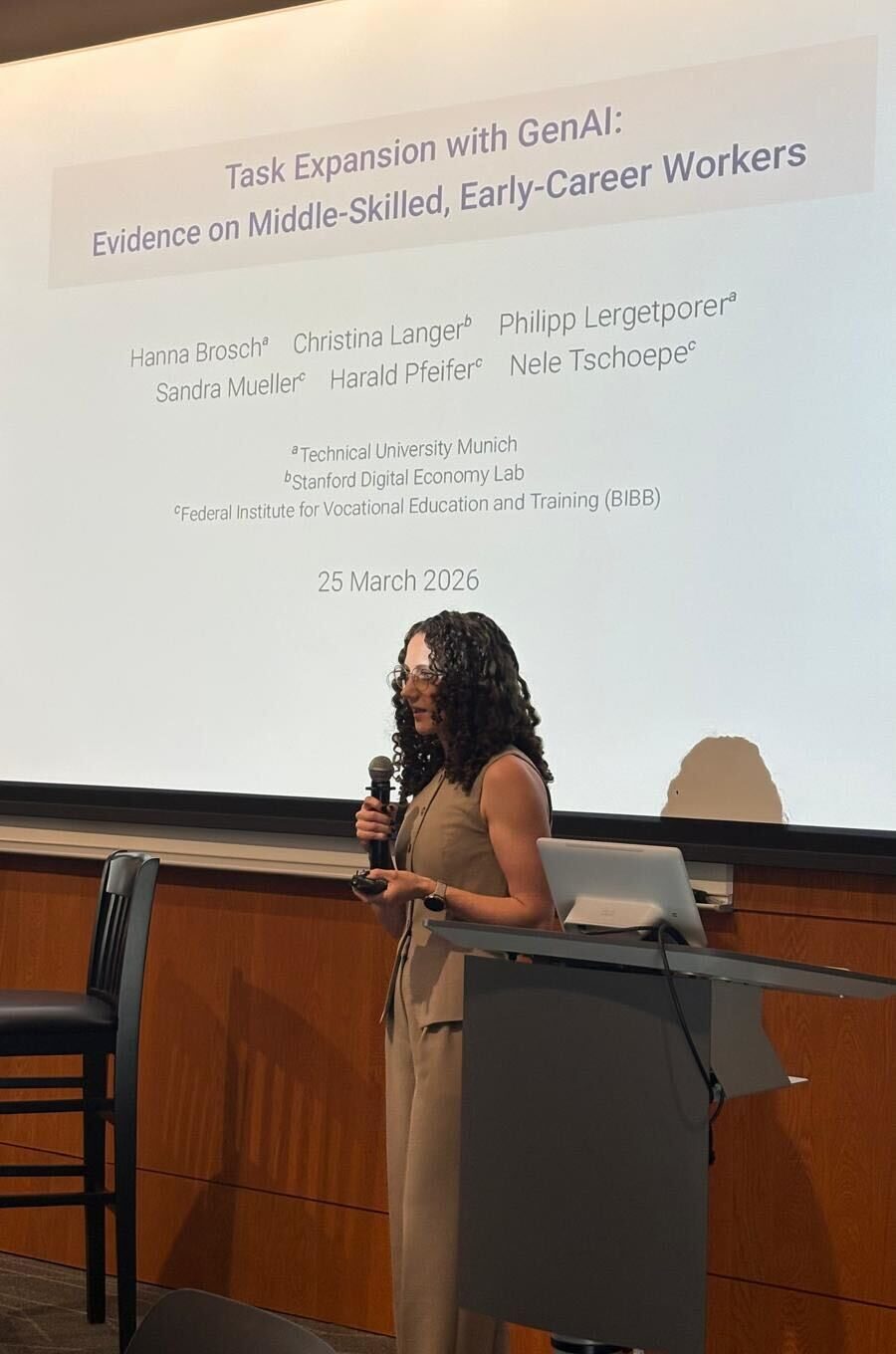
Task Expansion with Generative AI: Experimental Evidence on Middle-Skilled, Early-Career Workers
Authors:
Hanna Brosch et al.
This project studies how access to generative AI affects the task range and understanding of apprentices in Germany’s dual vocational education system. Focusing on final-year IT apprentices in application development and system integration, we conduct a randomized controlled trial in vocational schools in which some apprentices receive access to generative AI tools while others complete the same tasks without internet or AI assistance.
The tasks range from standard apprenticeship-level work to more advanced tasks that go beyond the formal curriculum and resemble software-engineer-or IT infrastructure architect-level problem solving.
Our research examines whether generative AI enables middle-skilled, early-career workers to perform more advanced tasks, and whether these gains come at the expense of comprehension during a critical period of skill formation. We also study which apprentices benefit most, how effects vary by task difficulty, how apprentices interact with the AI tool, and whether AI literacy shapes the returns to AI use.
By combining experimental evidence with detailed task-level outcomes, this project provides rigorous evidence on how AI affects early-career workers in vocational training. The findings speak to broader questions about task expansion, human capital development, and the design of training systems in an economy where AI is becoming part of everyday work.