
Canaries Dashboard
A collaboration between ADP Research and the Stanford Digital Economy Lab, we track employment across occupations and worker groups with different levels of AI exposure.
Stanford Digital Economy Lab / August 12, 2026
We are releasing a revised version of “Canaries in the Coal Mine? Six Facts About the Recent Employment Effects of Artificial Intelligence.” Using payroll data from ADP, we document six facts about how employment has evolved since the release of ChatGPT, with particular attention to differences by age and AI exposure.
The updated data strengthen several patterns we first documented in August 2025. Most notably, the employment gap for young workers in highly AI-exposed occupations has continued to widen through mid-2026.
Our six main facts
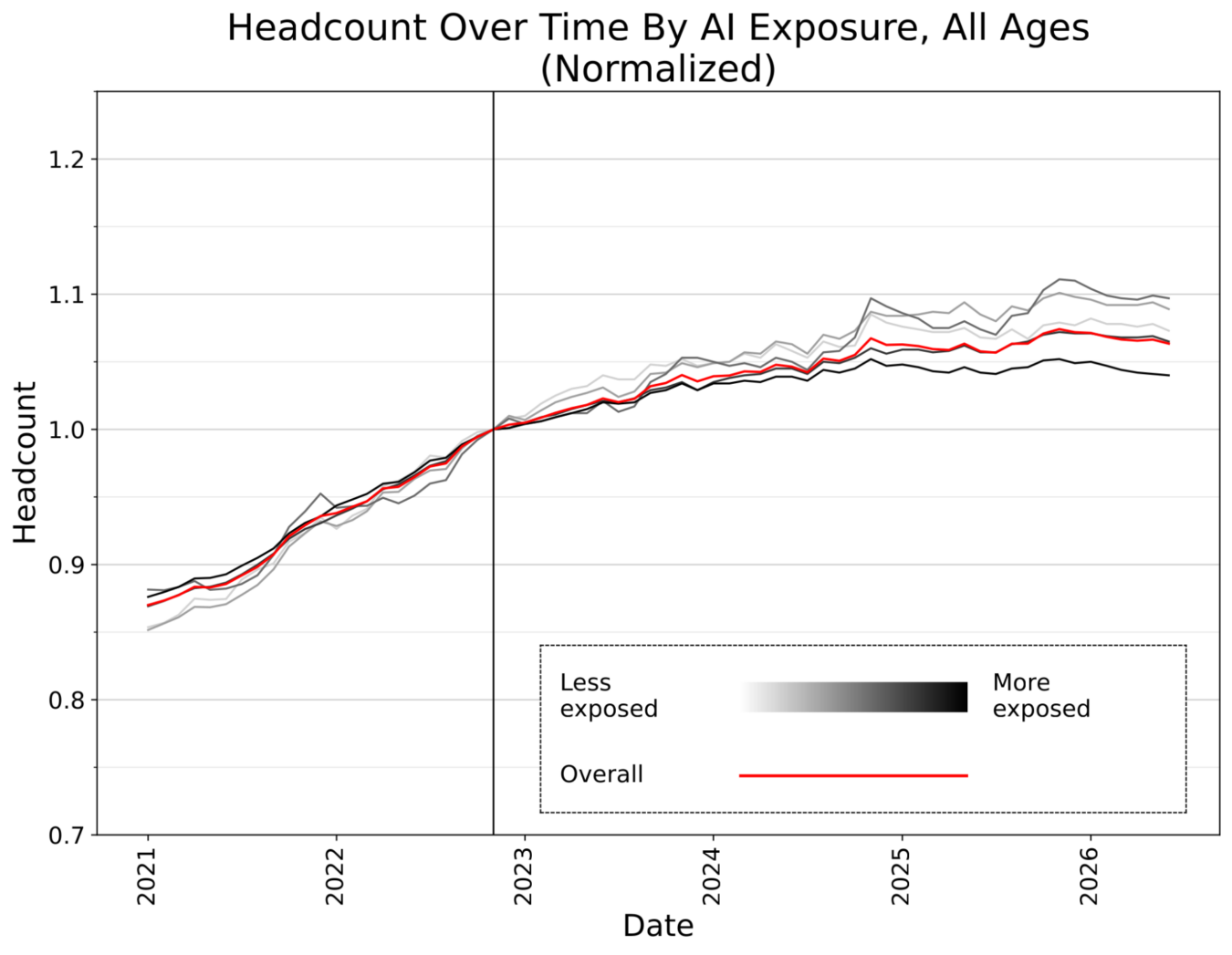
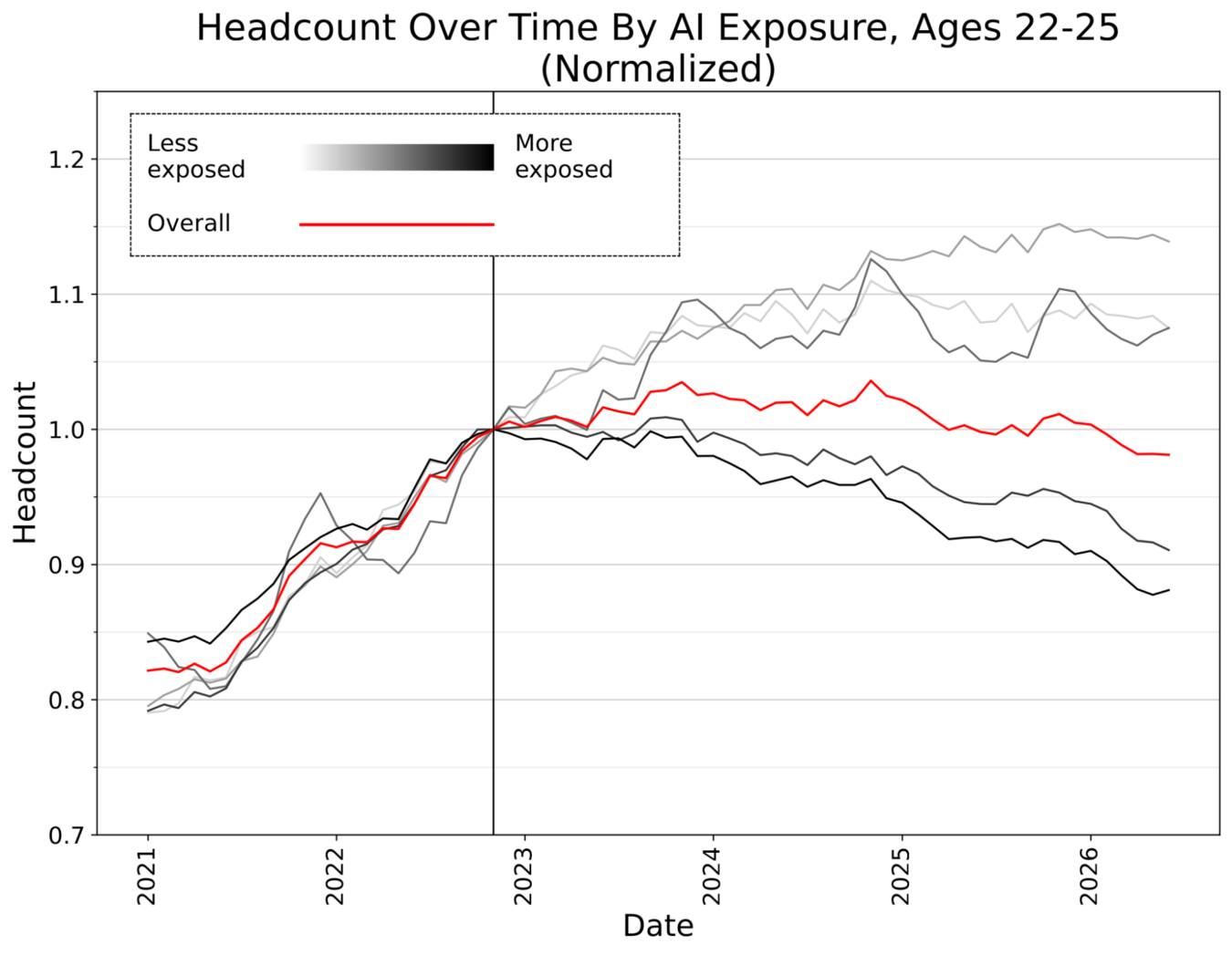
These are descriptive patterns, not causal estimates of the effect of AI. The timing and structure of the changes are suggestive, but the data alone cannot establish how much of the divergence was caused by generative AI rather than other forces affecting the labor market.
What is new in this revision
Beyond extending the data through mid-2026, the revised paper provides new evidence about the mechanisms that may be driving these patterns.
One distinction that appears important is between codified and tacit knowledge.
Employment has declined among young workers in occupations that rely heavily on codified knowledge: formal, standardized, documented knowledge that can be taught through education, textbooks, or written procedures. In contrast, employment has increased among experienced workers in occupations that rely more heavily on tacit knowledge acquired through practice, mentorship, and repeated exposure to real situations.
This distinction is consistent with a world in which generative AI is particularly effective at reproducing and applying knowledge that has already been encoded in text and other digital information, while experience-based knowledge remains harder to replicate.
We also find that women face greater AI exposure on average, an important source of heterogeneity that we intend to monitor as the data evolve.
Is AI causing these changes?
We cannot yet answer that question definitively.
Several prominent alternative explanations do not appear sufficient to account for the pattern. The divergence remains when we exclude technology firms and computer occupations, when we control for exposure to interest-rate increases and remote work, when we include firms that enter or leave the sample, and when we use alternative measures of AI exposure.
There are also several reasons to think AI may be playing a meaningful role:
At the same time, there are important reasons for caution.
The gaps between more- and less-exposed young workers shrink when we account for education. Some differential trends are visible before the widespread use of generative AI. The estimated gaps are also larger in the ADP analysis sample than in national survey benchmarks.3
In addition, improvements to our data pipeline produced qualitatively similar raw patterns, but estimates that account for overall changes in firm hiring are directionally consistent while becoming more sensitive to specification choices. This raises legitimate questions both about how much of the pattern is actually caused by AI and about how well the results in the ADP analysis sample generalize to the broader economy.
For those reasons, we do not view this paper—or any single study—as definitive evidence of AI’s labor-market effects. A growing body of research has appeared since the first version of our paper, and the cumulative evidence across studies will ultimately be more informative than any one result.
What comes next
We do not know whether the patterns documented here will accelerate, stabilize, or reverse.
That uncertainty is one reason we have invested in building the infrastructure to measure these changes continuously rather than relying on occasional snapshots.
The Stanford Digital Economy Lab recently launched the AI Economic Indicators, providing high-frequency measures of how AI is changing the economy. As part of that effort, our Canaries Dashboard will update the key results in this paper every month.
The goal is not to declare the labor-market effects of AI settled. It is to make them measurable.
If generative AI is beginning to reshape opportunities for particular groups of workers before its effects are visible in aggregate employment statistics, we want to identify those changes early, understand the mechanisms behind them, and track whether they spread.
That is, after all, what canaries are for.
View the revised paper

Jerry Yang and Akiko Yamazaki Professor
Erik Brynjolfsson is one of the world’s leading experts on the economics of technology and artificial intelligence. He is the Jerry Yang and Akiko Yamazaki Professor and Senior Fellow at the Stanford Institute for Human-Centered AI (HAI), and Director of the Stanford Digital Economy Lab. He also is the Ralph Landau Senior Fellow at the Stanford Institute for Economic Policy Research (SIEPR), Professor by Courtesy at the Stanford Graduate School of Business and Stanford Department of Economics, and a Research Associate at the National Bureau of Economic Research (NBER).
One of the most-cited authors on the economics of information, Brynjolfsson was among the first researchers to measure productivity contributions of IT and the complementary role of organizational capital and other intangibles.
Read more
Research Director, AI Economics and Policy
Bharat Chandar is a labor economist working on understanding AI’s impact on work. His recent projects include work with Erik Brynjolfsson and Ruyu Chen tracking “canaries in the coal mine” for entry-level employment changes in jobs exposed to AI. He also recently surveyed the state of knowledge about AI and labor markets.
His ongoing work has focused on three areas. The first asks, how will workers adjust if we see AI-driven changes in hiring? Which workers will have an easier or more challenging time if displaced, and where should we target support? The second asks, how can we use AI to make it easier for people to learn new things and pursue new forms of work? Third, how will impacts of AI differ across the world?
Read more
Research Scientist
Ruyu Chen is a research scientist at the Digital Economy Lab and the Stanford Institute for Human-Centered Artificial Intelligence (HAI). Her research lies at the intersection of the economics of innovation, information systems, and business strategy.
She focuses on two main areas: information technology adoption and firm performance, where she examines the drivers of IT adoption within firms and its impact on innovation and market performance; and AI and the future of work, where she leverages large-scale payroll data to study how emerging technologies, particularly generative AI, are reshaping employment, wages, skill demands, and organizational structures. Her work has been published in leading academic journals, including the Strategic Management Journal.
Read more