Canaries Dashboard
Workers are differentially exposed to AI-driven displacement or growth based on both their occupation and experience. Accordingly, exposed segments of the labor market can provide a leading indicator of employment trends for the broader economy.
Brynjolfsson, Chandar, and Chen (2025) studied these emergent labor market impacts. In the Canaries dashboard, we now update and extend this work, presenting it alongside other labor market indicators.
Employment Trends Following the Introduction of ChatGPT in November 2022
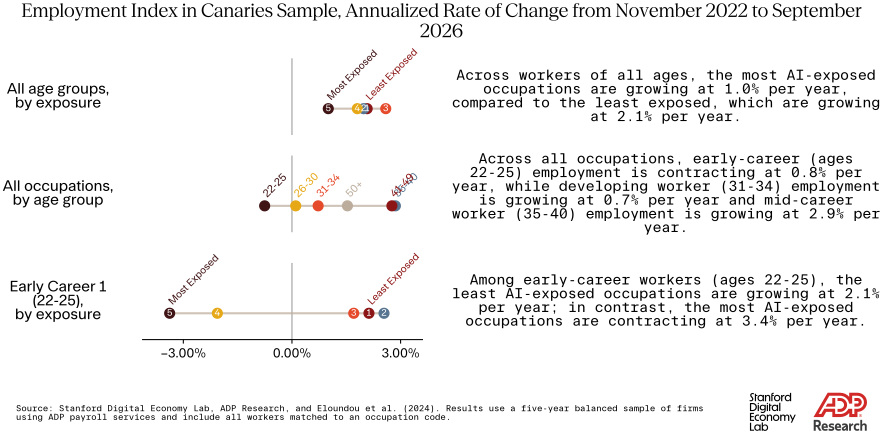
We group workers by their AI exposure score, comparing employment trends across these groups. We see modest differences between the five exposure groups, although employment growth is lowest for the most exposed occupations.
We group employees by their age and AI exposure scores, comparing employment trends across these groups. You can select different age groups. For early-career workers (22-25), the two most exposed groups of occupations see noticeable declines since the introduction of ChatGPT, while the other three occupation groups see growth. These patterns become less stark, and ultimately disappear, as we consider older workers.
We contextualize the AI exposure results with aggregate employment trends by age group, pooling all occupations. Consistent with the pattern in the previous chart, early-career workers (22-25) and the next-youngest group (26-30) see modest gains or slight declines. Given the narrow age range for early-career workers (22-25), this group accounts for just 7% of employment in our sample at baseline.
We summarize the composition of the sample of workers in November 2022. At this date, corresponding to the release of ChatGPT, the most exposed 20% of occupations account for a disproportionate share (34.0%) of employment in our sample. Given the narrow age range for early-career workers (22-25), this group accounts for just 7% of employment in our sample at baseline.
Software developers land in the most exposed occupations group. We see large declines for early-career workers (22-25), modest declines for the next-youngest groups, and expansion for the remaining age groups.
Customer service representatives are also assigned to the highest exposure group, and they indeed see similar trends to software developers: noticeable declines for the first two age groups, with expansion for the remaining age groups.
In contrast to software developers and customer service representatives, stock clerks fall in the second least exposed occupation group. There is little relationship between age and employment trends.
In contrast to software developers and customer service representatives, the relational and physical work of home health aides is minimally exposed to AI under most exposure frameworks: this cluster of occupations spans the least and second least exposed groups. Early-career workers (22-25) now see larger employment gains than the other age groups.
Results are updated monthly, beginning in late June 2026.
The Canaries Dashboard relies on data provided by our relationship with ADP, the largest payroll provider in the United States. While preserving privacy, this employment data contains in-depth information about industries, roles, geographies, and more. As a result of this collaboration, the Lab’s insights are not just comprehensive, but current, reflecting employment trends with minimal lag between collection and deployment.
Notable findings from recent releases
Employment growth is slowest in the most AI-exposed occupations
Since the introduction of ChatGPT in November 2022, all exposure groups see employment growth, but the rate of expansion is slowest for the two most-exposed occupation groups. However, these differences remain modest.
Early-career workers show the strongest exposure-related divergence
Less-exposed occupations for early-career workers show growth, while the employment declines in exposed occupations not only persist, but deepen. This divergence is still concentrated among early-career workers, but we see muted evidence of similar patterns for workers up to age 34.
Employment changes are concentrated in specific occupations
For example, early-career software developers and customer service workers show substantial employment declines. On the other hand, home health aides, a less-exposed occupation, show employment increases for the youngest workers. Employment changes continue to be unevenly distributed throughout the labor market.
Occupations with heavy automation vs. augmentation usage show different trends
There is no clear monotonic relationship between the share of usage classified as augmentation and employment trends. However, the automation ratio shows a clear correlation with employment trends: occupations with a higher share of automation in total usage see declines or more muted increases in the employment index. Accordingly, the character of AI usage could shape the labor market effects of AI.
Automation vs. Augmentation
Canaries in the Coal Mine additionally studies how the type of AI usage correlates with employment trends. The Anthropic Economic Index summarizes total usage at the occupation level and further decomposes this usage into automation and augmentation patterns. Under automation, users fully delegate tasks, whereas augmentation usage features collaboration between humans and an AI system. These types of usage patterns could have very different implications for the labor market. Canaries in the Coal Mine supports this prediction:
Entry-level employment has declined in applications of AI that automate work, with muted changes for augmentation.
We update these results with the latest data the Anthropic Economic Index.
Employment Trends by Usage Pattern Following the Introduction of ChatGPT in November 2022
We group employees by their age and their occupations’ Anthropic Economic Index augmentation and automation ratios. Among early-career workers, the automation ratio shows a noticeable relationship with employment trends: occupations with a higher automation ratio see declines or more muted increases in the employment index. In contrast, the augmentation ratio does not show a clear relationship with employment trends for early-career workers.
We summarize the composition of the sample of workers in November 2022 by age and the share of augmentation usage in total usage (augmentation ratio). We include a separate category for occupations with zero observed usage.
We summarize the composition of the sample of workers in November 2022 by age and the share of automation usage in total usage (automation ratio). We include a separate category for occupations with zero observed usage.
The Canaries dashboard sits among related efforts to measure the labor market impacts of AI. We use low-latency data on a large, but not necessarily representative, sample of firms. The data, provided by our collaboration with ADP Research, afford us occupational granularity and timely updates to our results.
Further, the Canaries Dashboard uses a balanced sample of firms, focusing on the evolution of employment within a large set of firms, shutting down the margins of firm entry and exit.
The occupational granularity and timeliness of our results afford an early signal of changes to the labor market, a canary in the coal mine. Accordingly, the Canaries Dashboard complements, rather than substitutes for, analyses that make use of nationally representative datasets.
We present employment trends in the Canaries sample as our primary results in this dashboard. Brynjolfsson, Chandar, and Chen (2025) include similarly constructed aggregates as well as event-study regressions which attempt to control for confounding factors.
The authors elaborate on these results in their February 2026 update where they find that, when including the broadest set of controls, timing of decline in AI-exposed occupations only becomes “significant” in 2024, while earlier declines are likely influenced by non-AI factors.
Accordingly, the Canaries Dashboard measures the correlation between occupational exposure measures and employment trends in our sample, rather than a causal link between the two.

We adopt the balanced sample approach of Brynjolfsson, Chandar, and Chen (2025), including firms with 5 years of employment history in ADP. This sampling strategy mitigates the influence of the changing composition of ADP firms. Each month, we roll this 5-year window forward.
We match occupations across various occupational classification systems using the Bureau of Labor Statistics 2018 SOC Crosswalk. We match the occupation-level ADP data to various measures of exposure: Eloundou et al. (2024) and the Anthropic Economic Index. When grouping occupations by exposure metrics, we weight all occupations equally, rather than by employment counts.
Future versions of this work will use an expanded and reweighted sample.
The Canaries Dashboard uses data from ADP, a global leader in HR and payroll solutions. ADP is the largest payroll processing firm in America: the company provides payroll services for firms employing over 26 million workers in the U.S. We largely follow the methodology of Brynjolfsson, Chandar, and Chen (2025) to construct the Canaries Dashboard. We group occupations by the AI exposure scores of Eloundou et al. (2024), and then track employment trends within each group. We additionally group workers by age.
We use a 5-year balanced sample of firms using ADP payroll services, removing firms that enter or exit the sample during the period. This restriction limits the extent to which our analysis reflects reallocation of employment between firms, entry and exit of firms, and firms that change their payroll provider.Our analysis focuses on the evolution of employment for a given sample of firms. We additionally limit our sample to workers successfully matched to an occupation code. These two sampling restrictions depart from the methodology ADP Research uses in their National Employment Report, and our sample does not represent the entire U.S. labor market or the universe of firms using ADP payroll services.
As of the Canaries Dashboard launch, our balanced sample of firms using ADP payroll services, spanning the 5 years ending in April 2026, consists of 25,000 firms. In November 2022, these firms employed 4.6mm workers successfully matched to an occupation code. Additionally, this sample contains over 730 unique occupations.
Employment is not distributed evenly by exposure. In November 2022, the least exposed quintile accounts for 6.4% of employment in our sample, while the most exposed quintile accounts for 38.3%. The middle three quintiles constitute 13.7%, 13.9%, and 27.7%, respectively.
While the ADP data include millions of workers in each month, the distribution of firms using ADP services does not exactly match the distribution of firms across the broader US economy.
In all, our collaboration with ADP Research provides low-latency data on employment trends for a large sample of firms with a high degree of occupational granularity: we track employment for over 730 occupations. Accordingly, our analysis is a complement to other studies that use representative datasets that might have less occupational granularity or are released with a lag.
We are now transitioning out of this investment phase into a harvest phase where those earlier efforts begin to manifest as measurable output.
Video
DEL Research Team
Erik Brynjolfsson is one of the world’s leading experts on the economics of technology and artificial intelligence. He is the Jerry Yang and Akiko Yamazaki Professor and Senior Fellow at the Stanford Institute for Human-Centered AI (HAI), and Director of the Stanford Digital Economy Lab. He also is the Ralph Landau Senior Fellow at the Stanford Institute for Economic Policy Research (SIEPR), Professor by Courtesy at the Stanford Graduate School of Business and Stanford Department of Economics, and a Research Associate at the National Bureau of Economic Research (NBER).
One of the most-cited authors on the economics of information, Brynjolfsson was among the first researchers to measure productivity contributions of IT and the complementary role of organizational capital and other intangibles.
Read moreBharat Chandar is a labor economist working on understanding AI’s impact on work. His recent projects include work with Erik Brynjolfsson and Ruyu Chen tracking “canaries in the coal mine” for entry-level employment changes in jobs exposed to AI. He also recently surveyed the state of knowledge about AI and labor markets.
His ongoing work has focused on three areas. The first asks, how will workers adjust if we see AI-driven changes in hiring? Which workers will have an easier or more challenging time if displaced, and where should we target support? The second asks, how can we use AI to make it easier for people to learn new things and pursue new forms of work? Third, how will impacts of AI differ across the world?
Read moreRuyu Chen is a research scientist at the Digital Economy Lab and the Stanford Institute for Human-Centered Artificial Intelligence (HAI). Her research lies at the intersection of the economics of innovation, information systems, and business strategy.
She focuses on two main areas: information technology adoption and firm performance, where she examines the drivers of IT adoption within firms and its impact on innovation and market performance; and AI and the future of work, where she leverages large-scale payroll data to study how emerging technologies, particularly generative AI, are reshaping employment, wages, skill demands, and organizational structures. Her work has been published in leading academic journals, including the Strategic Management Journal.
Read moreConnacher Murphy is a research manager at DEL, where he works with lab scholars to turn their research on the economic impacts of AI into low-latency, regularly updated measures of the economic impacts of AI. He also pursues new research partnerships for this work. These efforts are housed under the forthcoming Stanford AI Economics Observatory.
Connacher is interested in the economic and social impacts of AI, both for their relevance to policy and as strong proxies for capabilities.
Read moreAndrew Wang is a research scientist at the Stanford Digital Economy Lab.
He is interested in technology, innovation, productivity, and the workforce. His prior work experience includes program evaluation and R&D project management in federal government at the National Institute of Standards and Technology, and in public-private partnership programs for early-stage R&D, where he interacted with both start-ups and large corporate R&D centers.
Andrew received a BA in history and economics from the University of California, Berkeley, and a PhD in economics from Harvard University.
Read moreNatania is a pre-doctoral research fellow who studies how the rapid adoption of generative AI technologies is reshaping the labor market––from shifts in skill demand and changes in employment and earnings, to the evolving nature of where and how people work. Her research focuses on identifying who benefits, who is left behind, and how policy can support workers during periods of technological change.
Read moreADP Research Team
Dr. Nela Richardson is ADP’s Chief Economist and ESG Officer. Nela is the head of the ADP Research Institute (ADPRI), where she leads economic research and provides reliable and timely analysis for the public, global and local businesses, and policymakers. Her background and expertise cross many industries, including finance, technology, housing and labor.
Canaries in the wild