
GDP-B: Surplus Observer
What is generative AI worth?
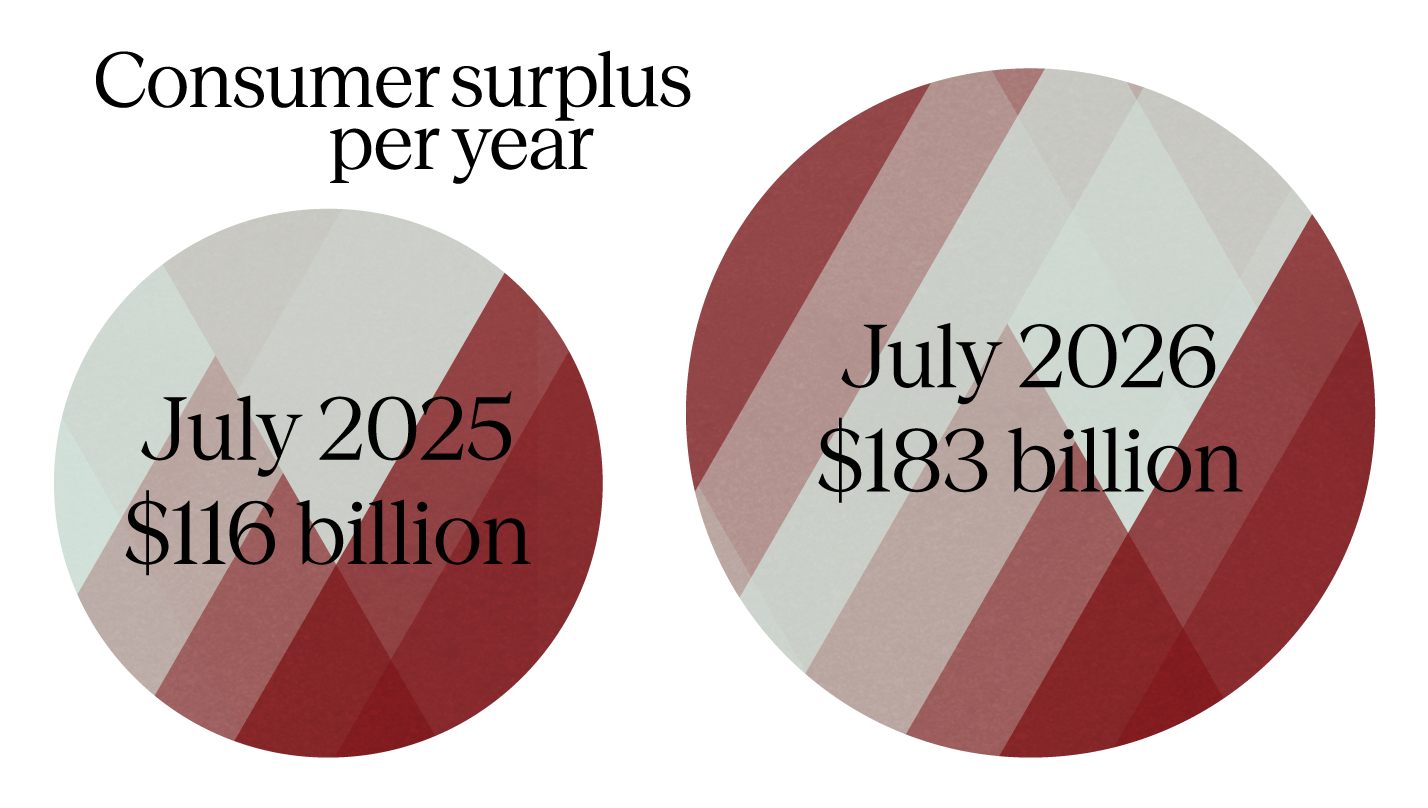
GDP-B measures how much consumers benefit from goods and services, not just how much they pay.
On this page, we track consumer surplus from generative AI tools over time, allowing us to understand the dynamics and components of the consumer welfare contributions of AI.

Despite their rapid and widespread adoption, the effects of generative AI tools like ChatGPT, Gemini, Claude, or Copilot are not yet fully reflected in official economic statistics like GDP and productivity. This is a modern version of the Solow paradox: as with earlier waves of computing, the benefits of a transformative technology may take time to appear in aggregate statistics.
The ‘B’ stands for benefits
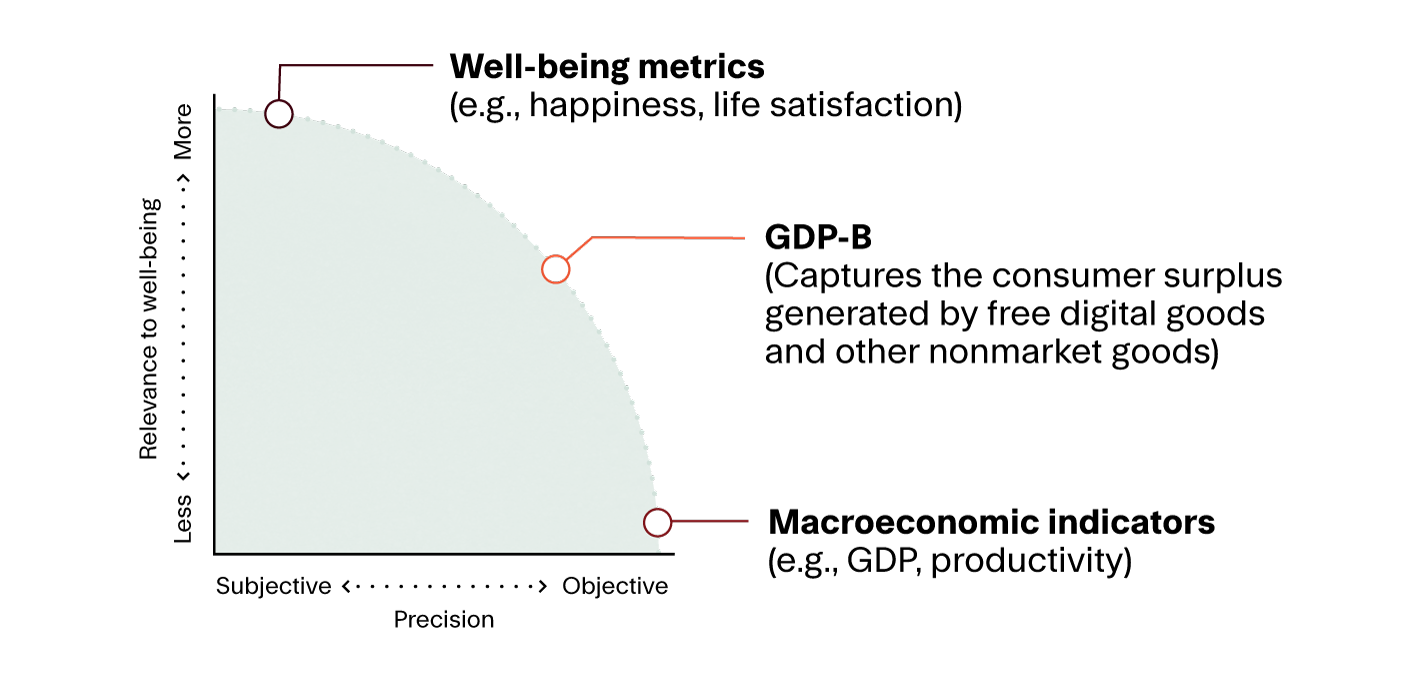
Gross Domestic Product (GDP) is the sum of the value of all goods and services produced in a country in one year, where price is a proxy for value.
Developed in the 1930s and reported quarterly, GDP remains the dominant metric economists and policymakers look to for analyzing the health of our economy and setting economic policy.
But as a measure of market-based production and consumption, GDP does not account for most aspects that make life worth living. It also excludes volunteering and work done at home that is not paid for with money, including caring for children and the elderly.
People generally prefer better health, less environmental pollution, increased personal safety, more public parks and green spaces, fewer armed conflicts, safer roads and less traffic, high-quality cultural amenities, etc.
Yet, improvements in these areas often do not show up in GDP. Other welfare-decreasing events such as accidents, pollution, or natural disasters can even increase GDP due to spending on repairs and clean-up activities.
Our approach starts from basic principles of economics: changes in well-being stem from changes in the economic surplus created by goods and services, rather than the money spent on them.
While deeply rooted in economic theory, the empirical measurement of “consumer surplus” was often thought of as too challenging. However, recent advances in massive online experiments have made this possible for a larger number of goods.
“What is Generative AI Worth?” (Brynjolfsson et al. 2026) describes the methods in detail.
We include results from three surveys:
- July 2026 (N = 1,500)
- March 2026 (N = 2,000)
- July 2026 (N = 2,000)
The surveys are fielded on Prolific with quotas to ensure that the samples are representative of the U.S. in terms of age, gender, and ethnicity.
Consumer Surplus and Willingness to Accept
Consumer surplus is the difference between the maximum price an individual is willing to pay for a good or service and the actual price of that good or service. It is a monetary measure of consumer welfare.
When a consumer pays less than the value they assign to a product, they derive surplus. This consumer surplus is largely not captured in GDP.
Willingness to accept (WTA) is the minimum compensation an individual will accept to give up or sell a certain good/service. In economics, WTA is used to measure the monetary value an individual ascribes to a certain good or service.
Would you give up access to coffee for one month starting tomorrow morning in exchange for $10? $100? $200?
The price we pay for a good is not always equal to how much we value that good.
Consumer surplus measures this difference: what is the gap between the total value we derive from the good and how much we pay for it? Consumer surplus can be measured on the classic supply and demand graph from Economics 101.
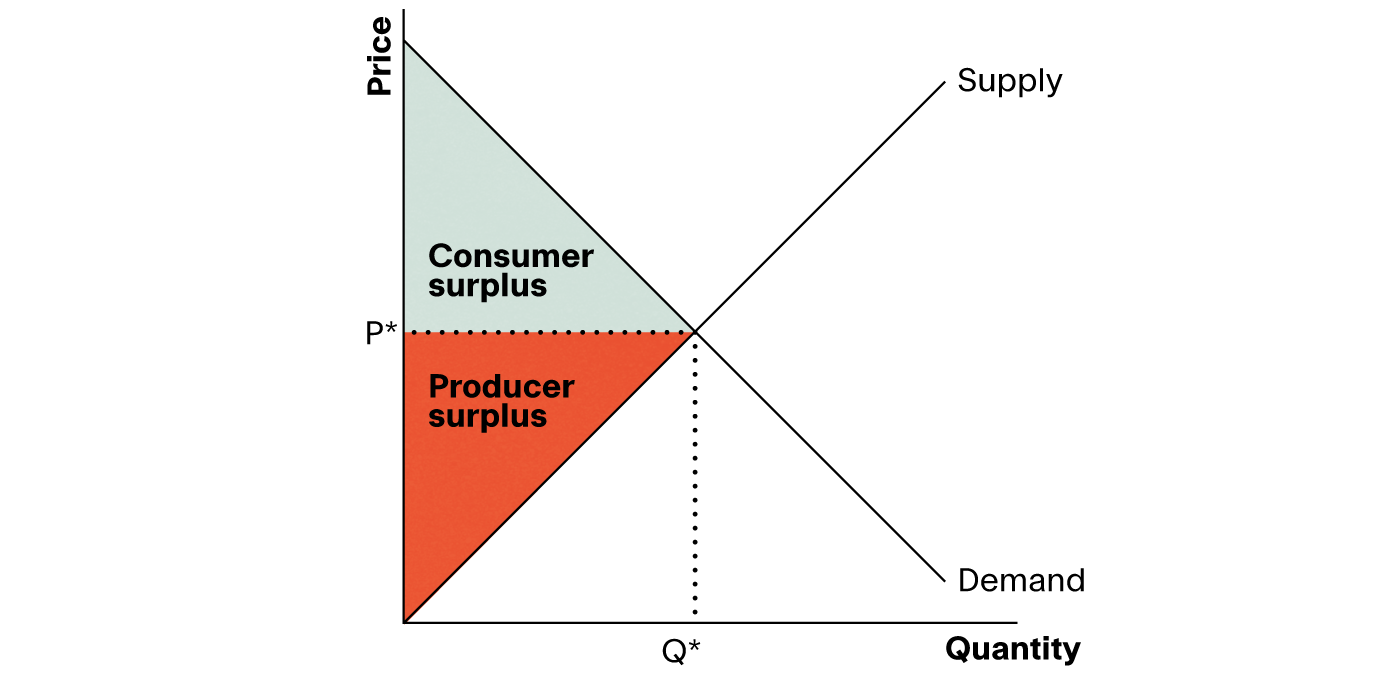
These gaps can be especially large for free and low-cost digital goods, but they show up throughout the economy.
How can you measure the value people place on goods they already own? We measure an individual’s willingness to accept compensation for giving up a good.
Importantly, when you forgo a good for this payment, you no longer need to purchase that good. Since these savings will be factored into a respondent’s decision, their stated willingness to accept is then equal to the consumer surplus they get from that good at its market price.
We measure the WTA for giving up generative AI and everyday products. Data are from July 2026. We report the average and median willingness to accept among users of the product.
Generative AI focus
Would you give up access to all AI tools like ChatGPT, Gemini, Claude, or Copilot for one month starting tomorrow morning in exchange for $10? $100? $200?
We combine information from our WTA exercise with estimates of the number of users of generative AI tools in the U.S. to estimate aggregate consumer surplus.
Thus far, we focused on values individuals derive from goods they already consume. We reported only a measure of individual consumer surplus but not an aggregate one. We now describe these aggregates.
- In July of 2026, the average generative AI user would need to be paid $120 to give up access to these tools for a month. Multiplied by the 127 million users, this yields an aggregate consumer surplus of $183 billion per year.
- Willingness to accept grew by 22% from July 2025 to 2026, and total users grew by 29%. Combining these two effects, aggregate consumer surplus grew by 58% over the past year
This approach allows us to decompose changes in aggregate consumer surplus into changes driven by user growth versus changes driven by average valuations for any given user, as well as the interaction of the two.
To decompose changes we:
- WTA growth: multiply the user base in the first period by the change in WTA between the first and second period
- User growth: multiply the WTA in the first period by the change in users between the first and second period
- Interaction: any remaining change in surplus from the first and second period left unexplained. This change in surplus only exists due to both user and WTA changes.

Willingness to accept to “give up access to any AI tool like ChatGPT, Gemini, Claude, or Copilot for one month starting tomorrow morning.” The large gap between the mean and median suggests that a small amount of users derive outsized value from the product.
Aggregate consumer surplus is the product of average, user-level surplus and the number of users. We report a survey-based estimate of the user base for generative AI tools in the U.S.
We decompose changes in aggregate consumer surplus into the changes driven by user growth versus individual-level valuations, as well as the interaction of these two components. While growth from July 2025 to March 2026 was largely driven by growth in individual-level valuations, the pattern reversed in the March to July 2026 period. Individual-level valuations fell slightly during these months.

What is Generative AI Worth?
Erik Brynjolfsson, Avinash Collis, Felix Eggers, Sophia Kazinnik, and David Nguyen
GDP-B Research Team
Erik Brynjolfsson is one of the world’s leading experts on the economics of technology and artificial intelligence. He is the Jerry Yang and Akiko Yamazaki Professor and Senior Fellow at the Stanford Institute for Human-Centered AI (HAI), and Director of the Stanford Digital Economy Lab. He also is the Ralph Landau Senior Fellow at the Stanford Institute for Economic Policy Research (SIEPR), Professor by Courtesy at the Stanford Graduate School of Business and Stanford Department of Economics, and a Research Associate at the National Bureau of Economic Research (NBER).
One of the most-cited authors on the economics of information, Brynjolfsson was among the first researchers to measure productivity contributions of IT and the complementary role of organizational capital and other intangibles.
Read moreAvinash is an Associate Professor at the Heinz College of Information Systems and Public Policy at Carnegie Mellon University. He is also a digital fellow at the MIT Initiative on the Digital Economy and the Stanford Digital Economy Lab. He holds a Ph.D. from the Sloan School of Management at the Massachusetts Institute of Technology. Avinash does research on the Economics of Digitization and teach courses related to Information Technology and AI. He is a co-creator of GDP-B, which is a new measure of welfare and growth in the digital economy.
Avinash’s research has been covered in major media outlets and policy reports worldwide, including the New York Times, Wall Street Journal, Washington Post, the Economist, CNN, BBC, Financial Times, Bloomberg, and NPR, and reports by the US White House, Federal Reserve, Senate, and UK treasury. He has also been invited to present my research at the OECD, European Commission, IMF, and the Bureau of Economic Analysis. Previously, he was a member of the Federal Economic Statistics Advisory Committee (FESAC), which advises the Directors of the Department of Commerce’s statistical agencies, the Bureau of Economic Analysis and the U.S. Census Bureau, and the Commissioner of the Department of Labor’s Bureau of Labor Statistics.
Read moreSophia Kazinnik is a Research Scientist at Stanford’s Digital Economy Lab (HAI), where she builds generative AI systems to explore how language and behavior shape economic outcomes. Her work turns economic questions into computable experiments, using LLM-powered agents and multi-agent simulations to study financial fragility, policy communication, and market expectations. In some of her recent projects, she has modeled bank runs, simulated FOMC deliberations, and evaluated how today’s AI interprets central bank language.
David is an expert on economic measurement, statistics, and indicators related to the digital economy. His work aims to provide a better evidence base for policy and business. David is also a Research Associate at the Economic Statistics Centre of Excellence (ESCoE) which has been created to address the challenges of measuring modern economies. He published several papers and reports in the fields of economic measurement and digital economics and previously worked as an Economist at the OECD in Paris and NIESR in London. David received his PhD from the London School of Economics in 2018.
Read moreXiupeng Wang’s primary research interest is labor economics with a focus on the relationship between technology advances and labor market dynamics.
His other interests include public policy, industrial organization, macroeconomics, and the economics of science and engineering.
Prior to earning his PhD, Xiupeng earned a Master of Science in physics from New Jersey Institute of Technology.
Read more